Tuesday 14th June 2016 - Nob End

Nob End is a small site almost totally enclosed by the rivers Croal and Irwell and the former Manchester, Bolton and Bury Canal. It is close to Moses Gate Country Park and near Little Lever and Farnworth.

According to Wikipedia, 'the site was used around 1850-70 as a tip for toxic alkaline waste from the production of sodium carbonate (soda ash.) The waste, known as "galligu", was a blue sludge dominated by calcium sulphide and smelling of bad eggs. The surface of the waste has since weathered down to calcium carbonate, and calcicolous vegetation has colonised the site. As natural limestone grassland does not occur in Greater Manchester, many of the species found are rare in the county.'

Subsequently, Nob End became an SSSI in 1988 and a Local Nature Reserve in 2000.

There were many interesting plants, particularly orchids, seen on this visit.

Marsh Orchid - northern or southern (Dactylorhiza)
It was good to be able to enter from Cemetary Road, over the new bridge replacing the old Wilson's bridge that was closed for a few years. Just over this bridge we found the first orchids - marsh orchids (without identifying whether they were southern or northern marsh).

Common Broomrape (Orobanche minor)

Common Broomrape (Orobanche minor)
A little further on, close by the main path, we noticed the first of a number of spikes of the common broomrape. Sometimes known as clover broomrape - this gives away its host plant. It contains no chlorophyll, so obtains its nutrients by parasitising other plants, and this particular brromrape uses members of the pea family.

7-spot Ladybirds (Coccinella septempunctata)
A pair of ladybirds seemed pre-occupied and very tolerant of the local paparazzi.

Marsh Helleborine (Epipactis palustris)
Over the other side (towards NW corner) of the site a fair number of Marsh Helleborine are just coming into bud.

Twayblade (Neottia ovata)
There were about 3 spikes of Twayblade.

Early Marsh Orchid (Dactylorhiza incarnata)
Perhaps a few more spikes of Early Marsh Orchid.

Common Spotted Orchid (Dactylorhiza fuchsii)
Common-spotted Orchid is just beginning to flower. Expect to see many more of these in the next couple of weeks.

Other plants seen included : Guelder-rose, Giant Hogweed, Yarrow, Daisy, Smooth Hawk's-beard, Hemp-agrimony, Oxeye Daisy, Dame's-violet, Meadow Vetchling, Common Bird's-foot-trefoil, Black Medick, Zigzag Clover, Red Clover, White Clover, Tufted Vetch, Bush Vetch, Cut-leaved Crane's-bill, Selfheal, Lamb's-ear, Hedge Woundwort, Fairy Flax, Foxglove, Ribwort Plantain, Crested Dog's-tail, Common Bistort, Love-in-a-mist, Wild Strawberry, Wood Avens, Trailing Tormentil and Water Figwort

and birds: Swift, Cormorant, Wood Pigeon, Goldfinch, Wren and House Martin

Coot (Fulica atra)
Coot (Fulica atra)

Coot egg
Coot egg

A short drive to Moses Gate Country Park for a few minutes just before dusk, was worthwhile. This coot and nest were very close to the main lake - hope it is not too late for a successful hatch.
 
Other birds seen included: Mallard, Canada Goose, Mute Swan and Black-headed Gull

In the few metres between the car park to the lake we noticed many unfamiliar plants - very low with basal rosettes and small cruciferous flowers. Turned out to be Marsh Yellow-cress. Hemlock Water-dropwort was also seen in some profusion on the river bank - as it has been for many years.

A successful trip, with sightings of most of the species sought. The only one missing was Blue-eyed Grass. Obviously worth another trip in a couple of weeks,

Tuesday 10th May 2016 - Teggs Nose Country Park (Moonwort)

This visit was about a month earlier than usual to this excellent site. Unusually we tried a daytime rather than evening visit, allowing more time to wander slowly round the site, planning on a picnic lunch at a suitable, sheltered spot. After a few days of intense sunshine, the cloud and wind that greeted us was a little surprising, but we expected to stay dry.

As we were so much earlier, the lack of wild flowers in the meadows was not surprising. See June 2014 sightings for some of the meadow flowers.

Common Moonwort (Botrychium lunaria)
 However the lack of these flowers meant much shorter vegetation, giving greater hope of finding the diminutive moonwort. It was still surprising however to find this single, young specimen (given we found one there were likely many others). At about 2" high it is not yet fully developed, and has suffered a little from perhaps wind or sun scorching, but an exciting find! We have looked on all previous visits but never seen it here before.

From Wikipedia: This is a small plant growing from an underground caudex (basal stem structure) and sending one fleshy, dark green leaf above the surface of the ground. The leaf is 6 to 10 centimeters tall and is divided into a sterile and a fertile part. The sterile part of the leaf has 4 to 9 pairs of fan-shaped leaflets. The fertile part of the leaf is very different in shape, with rounded, grapelike clusters of sporangia by which it reproduces.

Mountain Pansy (Viola lutea)
It was also pleasing to find a good display of the mountain pansy, a specialist of this site, despite being so early and given that it started flowering about 2 weeks later this year than last year, according to the local Facebook pages.

Teggs Nose Summit - Cathy and Pat
The expected dry conditions did not survive, and with the increasing wind, the summit shelter provided a little respite.
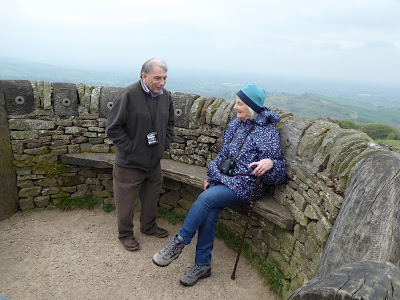
Teggs Nose Summit - Amy and John

Teggs Nose and Bottoms Reservoirs
Despite the limited visibility, the views are always worthwhile. Atmospheric, if not the usual dramatic.
Other flowers seen included Red Campion, Greater Spearwort, Pignut (probably), a Forget-me-not, with well-laden bilberry bushes, and not to forget the widespread and showy dandelions, and occasional daisy.
Pied wagtail, Carrion Crow and Kestrel were easily identified, while at least one Skylark was heard but seen only by John.
The rain was more persistent as we returned to the cafe for a little refreshment.
Despite the relatively poor weather, it was still an enjoyable trip and worthy of a more leisurely daytime visit.

Friday 6th/Saturday 7th May 2016 - Altrincham (First Swifts)

First swifts seen over Oxford Road, Altrincham on Friday 6th May. Also seen above Oak Road, Altrincham on Saturday 7th May - their traditional date of return.
Jacky Johnson

March/April - Timperley Tit Box Mystery

A pair of blue tits moved in to a nest box and were seen feeding 2 weeks later. They suddenly disappeared. Several days later one blue tit appeared calling non-stop and another appeared eventually - definitely courting. Now one bird is going into the nest with feathers etc and is feeding on the nuts nearby. Is this the same couple? A new couple? One from the original two? Did the original babies die or fly?
Claire Joures

Friday 15th April 2016 - Staffordshire Border (Ring Ouzels)

10 Ring Ouzels seen dropping in just over the border in Staffordshire, flying in from different directions.
Claire Joures

Tuesday 14th April 2016 - Baguley (Alexanders)


Alexanders (Smyrnium olusatrum)
Masses of Alexanders seen on the verge at the junction of the A560 and Shady Lane. Not common in this area.

Alexanders (Smyrnium olusatrum)

Harlequin Ladybird (Harmonia axyridis)
A ladybird on the plant was probably the invasive, predatory Harlequin Ladybird.

Alexanders Rust (Puccinia smyrnii)
Also found Alexanders Rust on the underside of some leaves.

Cathy Pettipher